LOS ANGELES – A 9-year-old girl crawled out of a mangled SUV, climbed out of a canyon and walked about a mile in the middle of the night to find help after surviving a highway crash that killed her father in Southern California, authorities said.
The 2010 Ford Escape was launched about 200 feet down an embankment along a semi-rural stretch of the Sierra Highway in Acton about 1 a.m. Sunday, said California Highway Patrol Officer Cheyenne Quesada. The vehicle overturned several times.
The girl managed to extricate herself and walk through rugged terrain to a nearby home, but nobody answered the door, the CHP said. Then she hiked up the steep embankment and along the road to a commuter rail station where she flagged down a passing motorist at about 2:30 a.m.
"She walked quite a distance in a very, very threatening environment. It's very black out there, very dark," CHP Sgt. Tom Lackey told KABC-TV. "It's very steep and it's brushy and there's also coyotes in the background."
Responding officers found a man in his 30s had been killed, Quesada said. His name was not released but officials said he was from Los Angeles.
A helicopter transported the girl to Children's Hospital Los Angeles. She was treated for minor injuries including bumps and bruises and a cut on her face.
Television footage showed crews extricating the severely damaged black SUV from the canyon.
The CHP is investigating whether alcohol played a role in the crash.
Downloaded from: here
luni, 25 martie 2013

Amputee veteran helps train US troops for war with film stu
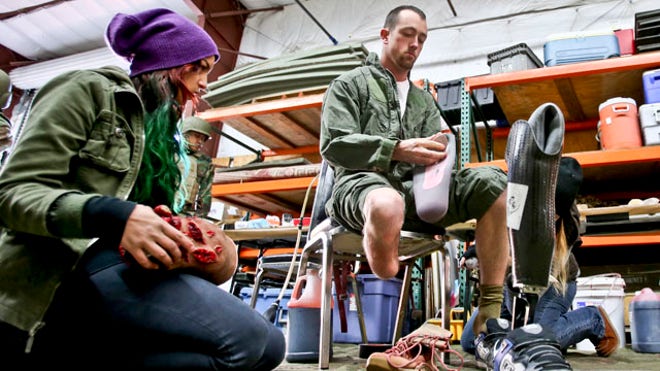
The U.S. sailor had been back from war for just over a year when friends invited him to watch an unusually emotional training exercise for troops preparing to deploy.
The drill happened not on a military base but at a film studio, where Marine and Navy medics role-played wartime rescue missions with actors who had, in real-life, lost limbs in motorcycle or car accidents or to ailments such as cancer.
Those on hand weren't sure how Joel Booth would react. The 24-year-old had been attached to a Marine battalion in Afghanistan as a naval combat medic -- until he stepped on an explosive and doctors, two years ago, amputated his right leg below the knee. Since returning home he'd had to learn to adapt while also coping with the post-traumatic stress.
But Booth was transfixed as fake bombs exploded and medics practiced the type of rescue missions he'd once been on, saving the amputee actors -- as he, in the end, had to be saved.
Then the young veteran did something unexpected: He asked for an audition.
Perhaps, he thought, this injury that had forever altered his life could help save someone else's. What he didn't know was how much reliving the horrors of war would help him, too.
"In society, amputees are seen by people on a large scale as having a disability, being weaker. But ... even someone who doesn't have a hand can still operate a weapon to be able to defend themselves," he said.
"It's the same thing for me. I'm not afraid of it just because something bad happened. For people who haven't been in combat, it's hard to understand."
Producer Stu Segall, best known for the TV police show "Silk Stalkings," started Strategic Operations in 2002 shortly after the launch of the Iraq war to offer the military what it calls "hyper-realistic" training by using movie-making special effects and actors.
The group has since trained hundreds of thousands of troops in recreated scenes from Iraq, Afghanistan, Somalia and other hotspots. The creators strive to make the re-enactments as jarring as possible so troops experience war first in a controlled environment, and learn not to be rattled by it.
Marine 2nd Lt. Duane Blank, a commander who has gone through similar training, said amputee actors add a degree of realism that no one else can.
"The visual effect is invaluable because it's something you don't encounter every day," said Blank, an Iraq war veteran. "There is no way to recreate that aspect of real combat, seeing a brother hurt in that sort of way."
Since the inception of Strategic Operations, the group's founders had made a concerted effort not to use veterans who lost limbs in combat.
"We felt it was one of those things: Why would you ask somebody who has gone through this experience to relive it? And we had plenty of amputee actors," said executive vice president Kit Lavell.
Lavell flew 243 missions in Vietnam as a naval aviator. He knows how hearing screams and explosions -- even on a studio lot in San Diego -- can quickly bring back the stress of battle for even the most hardened soldiers.
But Booth convinced Lavell to let him join the group.
"He was so well-prepared as a corpsman," Lavell said. "We felt: He's the perfect one to do this."
Booth first joined the Navy, at the age of 21, because he wanted to see combat and help save lives. The job of corpsman was perfect for him; as field medics in charge of providing emergency care to battleground troops, corpsmen often are caught in the thick of the action.
Almost a year after enlisting, he was deployed with the Marines to the Taliban stronghold of Sangin, Afghanistan. On July 21, 2011, while out on patrol, he and a Marine volunteered to return to base to get supplies. As they were walking, an explosion catapulted Booth onto his back.
He calmly told the Marine to check behind them for more improvised explosive devices. Then he looked down at his leg. There was no blood but the pain was excruciating and Booth couldn't stand up. His ankle bones had been crushed.
Two days later he was back in the U.S., where he underwent surgery after surgery. But Booth didn't want to be a patient. Frustrated with each failed operation and a growing infection, he pushed his doctors to amputate.
As a medic, Booth knew what his life would be like without a limb, and he wasn't afraid. He had seen fellow service members adapt relatively quickly to using a prosthetic. He figured he could return quickly to an active lifestyle, doing the things he enjoyed, like riding motorcycles.
Booth learned his tenacity from his dad, a Black Hawk helicopter pilot in the Gulf War who taught his son to remember when faced with a challenge: "It could be worse. Just get through it and get on with it."
On Nov. 29, 2011, doctors amputated Booth's lower right leg. He was fitted with his prosthesis, and began therapy three times a week to learn how to walk again.
But Booth soon noticed his injuries went beyond the physical. During the day, he felt on edge. At night, he had nightmares or insomnia. He started seeing a psychiatrist, who diagnosed him with post-traumatic stress disorder and prescribed medication.
He wondered what he would do with his life when some Navy instructors who were training young medics invited him to the film studio.
A year ago in April, Booth started work with Strategic Operations. He has now performed with the group a dozen times, and he isn't bothered by the gore and gunfire. Rather, said Booth, the exercises have helped him deal with his post-traumatic stress.
"When we're at the point where the explosions and the gunfire is going off, I'm in a whole different mindset. I'm yelling and screaming and waiting for the corpsmen to come help me. So I'm not really worried about that (PTSD) anymore," said Booth, who has since stopped taking his PTSD medication. "It's more so about the guys coming to get me and really helping them."
Mental health professionals said they are not surprised Booth has found solace in his role-playing.
"For many of these guys it doesn't get better than that -- to be able to know you are making a difference in the lives of people who are still in combat," said Nancy Commisso, a therapist with Easter Seals. "None of these guys want to be the patient -- especially corpsmen who tend to be the ultimate persona of strength and someone who wants to help."
Commisso has had veterans with PTSD re-enact their combat experiences to diffuse the emotions burdening them.
"If they can go through that and come out of it OK, then they know, `Whew!"' she said. "Then each time they do that, it can get better and better."
Lavell said having Booth has greatly enhanced the training because he bases his role-playing on his real-life experience, and is able to share tips that only a combat veteran can offer.
Earlier this year, Strategic Operations accepted its second veteran into the group: Redmond Ramos, another amputee corpsman whom Booth met while they were both recovering at the hospital.
On a chilly but sunny morning at the studio last month, shrill sirens pierced the air as smoke wafted from a crashed helicopter. A bloodied mannequin with no legs dangled from a strap off the rotor.
Booth sat under the prop, leaning against the aircraft. He jiggled his amputated leg to make it look like it was quivering. Marines scrambled to him, dodging Hollywood-style gunfire as Booth shouted: "Help me!"
One of the trainees fumbled as he hurried to put on a tourniquet and bandage.
Then he hoisted a limp Booth over his shoulder and ran as explosions boomed.
It was one of the numerous times that day Booth would be rescued.
Downloaded from: here
Landslide triggered by torrential rain kills 6, leaves 18 others missing in central Indonesia
BANDUNG, Indonesia – A government official says a landslide triggered by torrential rain has killed at least six people and left 18 others missing on Indonesia's main island of Java.
Sutopo Purwo Nugroho of the Disaster Mitigation Agency says nine houses were buried when mud gushed down from surrounding hills just after dawn Monday in Cililin village, West Bandung district.
He said rescuers pulled out six bodies, including four children, hours after the landslide.
Hundreds of police, soldiers and residents were digging through the debris, using their bare hands, shovels and hoes in search of the others reported missing.
Seasonal downpours cause dozens of landslides and flash floods each year in Indonesia, a vast chain of 17,000 islands where millions of people live in mountainous areas or near fertile flood plains.
Downloaded from: here
California man sets self on fire at nail salon where estranged wife works
California man sets self on fire at nail salon where estranged wife works
Published March 25, 2013
Associated Press
COSTA MESA, Calif. – A man was hospitalized after walking into the Orange County nail salon where his estranged wife worked, dousing himself in a flammable liquid and lighting himself on fire, police said Sunday.
The 46-year-old Asian man set fire to himself in Creative Nails & Spa shortly after noon, Costa Mesa police said. He suffered third-degree burns, police Sgt. Clint Dieball said.
A man inside the salon used a fire extinguisher to put out the flames, Dieball said. No one else was injured and the salon sustained minor fire damage.
Investigators have not determined a motive, but police said the man's estranged wife was working in the salon.
Sherry Skipper-Spurgeon, a longtime customer at the salon, said she was having her nails done by the store's manager when the manager's husband, with whom she has three children, came in appearing "very distraught" and began shouting at her in Vietnamese.
"He had a bucket with him, and he takes the bucket and pours this whatever liquid over the top of his head," Skipper-Spurgeon told the Orange County Register. "Then you could smell it, like gasoline."
The manager, whom she knew only as Lina, told the other employees and the three customers inside the store to step outside and her husband sat down on the floor, said Skipper-Spurgeon, who dialed 911.
"Next thing you know, someone says `He's got a lighter!"' Skipper-Spurgeon said. "As I'm talking to the fire department, he lights himself on fire, and there's a fireball. The flames are completely covering his head, and then there's this poof of smoke."
The manager's father and brother had been in the back of the store doing repairs and rushed out, the brother blasting the flaming man with a fire extinguisher as customers ran back in and used towels to help smother the flames.
Skipper-Spurgeon said the wife sobbed in her arms for about an hour after her husband was taken away.
"This is absolutely devastating for her," she said. "She didn't know how she was going to tell her kids about this."
Downloaded from: here
NYC art museum accused of duping visitors on admission fees

NEW YORK – Before visitors to the Metropolitan Museum of Art can stroll past the Picassos, Renoirs, Rembrandts and other priceless works, they must first deal with the posted $25 adult admission and the meaning of the word in smaller type just beneath it: "recommended."
Confusion over what's required to enter one of the world's great museums, which draws more than 6 million visitors a year, is at the heart of a class-action lawsuit this month accusing the New York City institution of scheming to defraud the public into believing the fees are required.
The lawsuit contends that the museum uses misleading marketing and training of cashiers to violate an 1893 New York state law that mandates the public should be admitted for free at least five days and two evenings per week. In exchange, the museum gets annual grants from the city and free rent for its building and land along pricey Fifth Avenue in Central Park.
Met spokesman Harold Holzer denied any deception and said a policy of requiring visitors to pay at least something has been in place for more than four decades. "We are confident that the courts will see through this insupportable nuisance lawsuit."
The suit seeks compensation for museum members and visitors who paid by credit card over the past few years.
"The museum was designed to be open to everyone, without regard to their financial circumstances," said Arnold Weiss, one of two attorneys who filed the lawsuit on behalf of three museum-goers, a New Yorker and two tourists from the Czech Republic. "But instead, the museum has been converted into an elite tourist attraction."
Among the allegations are that third-party websites do not mention the recommended fee and that the museum sells memberships that carry the benefit of free admission, even though the public is already entitled to free admission.
The Metropolitan Museum is one of the world's richest cultural institutions, with a $2.58 billion investment portfolio, and isn't reliant on admissions fees to pay the majority of its bills. Only about 11 percent of the museum's operating expenses were covered by admissions charges in the 2012 fiscal year. As a nonprofit organization, the museum pays no income taxes.
The Met's Holzer said the basis for the lawsuit -- that admission is intended to be free -- is wrong because the state law the plaintiffs cited has been superseded many times and the city approved pay-what-you-wish admissions in 1970.
"The idea that the museum is free to everyone who doesn't wish to pay has not been in force for nearly 40 years," Holzer said, adding, "Yes, you do have to pay something."
New York City's Department of Cultural Affairs agreed to the museum's request in 1970 for a general admission as long as the amount was left up to individuals and that the signage reflected that.
Similar arrangements are in place for other cultural institutions that operate on city-owned land and property and receive support from the city. It's also a model that's been replicated in other cities.
Holzer also noted that in the past fiscal year, 41 percent of visitors to the Met paid the full recommended admission price -- $25 for adults, $17 for seniors and $12 for students.
A random sampling of visitors leaving the museum found that there was a general awareness that "recommended" implied you could pay less than the posted price.
But Dan Larson and his son Jake, visiting the museum last week from Minnesota, were unaware there was any room to negotiate the admission price. They paid the full $25 each for adult tickets.
"My understanding was you pay the recommended price," said Larson, 50. "That's clearly not displayed."
Alexander Kulessa, a 23-year-old university student from Germany, said friends tipped him off about the admission fee.
"They said, `Don't pay $25,"' said Kulessa. "They said it will be written everywhere to pay $25, but you don't have to pay that."
For Colette Leger, a tourist from Toronto, paying the full $25 was worth it.
"It's a beautiful museum, and I was happy to pay," she said.
Downloaded from: here
Officials to release information on winning ticket for $338M Powerball sold in NJ

The lottery fantasies of mansions, luxury boats and unlimited travel are over for most people. But for the owner -- or owners -- of the lone winning ticket sold in New Jersey for Powerball's $338.3 million drawing they're just beginning.
New Jersey Lottery officials will release information on the ticket at a news conference Monday morning at the lottery's headquarters in Lawrenceville.
Details on where and when Saturday's winning ticket was purchased and other related information were not disclosed Sunday by officials, who also would not say if anyone claiming to hold the ticket had contacted them.
Lottery officials say it was the fourth-largest jackpot in Powerball history. The numbers drawn were 17, 29, 31, 52, 53 and Powerball 31. A lump sum payout would be $221 million.
Retailers in New Jersey said the growing jackpot had spurred a big boost in ticket sales in recent days, and many people were willing to stand in long lines to get their tickets.
"We are hoping that we sold it here because that would be a blessing for one of our customers in these tough times," said a worker at a Camden area convenience store.
When Teddy Jackson heard Sunday morning that the winning Powerball ticket was sold in New Jersey, the Toms River resident combed through his 40 tickets and hoped for the best.
About 20 minutes later, after checking each ticket at least a couple times, Jackson realized he would have to go work on Monday.
"There were a few where I had one or two numbers, but that was it," the 45-year-old electrician said Sunday.
"I hope whoever wins does good things with the money," Jackson said. "It's OK to buy yourself a few material things and take some trips, but $338 million can do a lot of good things. Help the people who lost their jobs, the ones who got destroyed by (Superstorm) Sandy, the folks dealing with serious medical problems ... don't become one of these stupid people who get a windfall and blow it all."
Lottery officials said 13 tickets worth $1 million apiece -- matching the first five numbers but missing the Powerball -- were sold in Arizona, Florida (2), Illinois, Minnesota, North Carolina, New Jersey, New York, Ohio, Pennsylvania (2), South Carolina and Virginia.
Powerball said on its website that the grand prize jackpot has now been reset to an estimated $40 million or a lump sum cash amount estimated at $25 million for Wednesday's next drawing.
No one had won the Powerball jackpot since early February, when Dave Honeywell in Virginia bought the winning ticket and elected a cash lump sum for his $217 million jackpot.
The largest Powerball jackpot ever came in at $587.5 million in November. The winning numbers were picked on two different tickets -- one by a couple in Missouri and the other by an Arizona man -- and the jackpot was split.
Nebraska still holds the record for the largest Powerball jackpot won on a single ticket -- $365 million. That jackpot was won by eight workers at a Lincoln meatpacking plant in February 2006.
Powerball is played in 42 states, Washington, D.C., and the U.S. Virgin Islands. The chance of matching all five numbers and the Powerball number is about 1 in 175 million.
Powerball said on its website that the game is played every Wednesday and Saturday night when five white balls are drawn from a drum of 59 balls and one red ball is picked from a drum with 35 red balls. It added that winners of the Powerball jackpot can elect to be paid out over 29 years at a percentage set by the game's rules -- or in a lump sum cash payment.
Downloaded from: here
Defense expert returns to witness stand for sixth day in Jodi Arias' Arizona murder trial
PHOENIX – A defense expert who diagnosed Jodi Arias with post-traumatic stress disorder and amnesia returns to the witness stand for a sixth day of testimony.
Arias faces a possible death sentence if convicted of first-degree murder in the 2008 killing of Travis Alexander in his suburban Phoenix home. Authorities say she planned the attack on her lover. Arias initially told authorities she had nothing to do with it then blamed it on masked intruders. She later said it was self-defense.
Psychologist Richard Samuels answered more than 100 jurors questions last week, most focused on Arias' lies and how Samuels could be sure she is telling the truth now.
Arizona is one of a few states where jurors have a legal right to query witnesses through written questions read by the judge.
Downloaded from: here
Abonați-vă la:
Postări (Atom)